Understand the simulated hazard
Review the container-transfer objective, available tools and no-touch constraints. How did the group coordinate the shared transfer apparatus?
Learning focusReading simulated constraints
A simulated handling task asks teams to move a harmless object within a set of constraints. Coordination matters because each person can influence only part of the transfer.
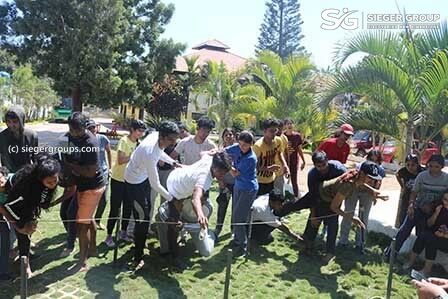
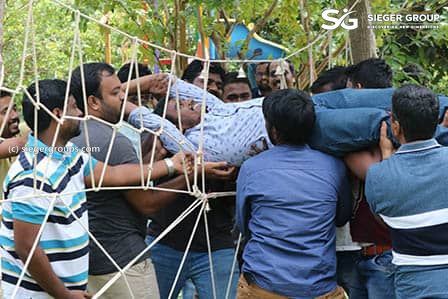
The team is asked to move a simulated load while respecting a marked boundary and the rules of the challenge. Everyone’s movement affects the shared transfer. The review focuses on who noticed a problem and how the group agreed on a correction.
Check whether the person closest to the object can communicate a change to the whole team.
Watch a team coordinate a shared transfer task. Look for the moment the group changes its plan in response to the movement of the equipment.

These photographs show related team sessions from the Sieger Group library.


Review the container-transfer objective, available tools and no-touch constraints. How did the group coordinate the shared transfer apparatus?
Compare ways to use the equipment while keeping the task's boundaries clear. Which movements affected the container’s position?
Observe the container's movement and adjust the shared approach within the rules. What helped participants communicate adjustments without competing instructions?
Discuss which tool combination and communication pattern helped the task progress. How did the team revise its plan after an unsuccessful transfer?
Use these points to draw out what colleagues can learn from Toxic Waste Team Simulation.
Reflect on how individual inputs combined to influence the container.
Consider how the constraint encouraged a different way to solve the transfer problem.
Confirm an accessible activity space, the agreed equipment, group rotations and an observer option.
Observe the container's movement and adjust the shared approach within the rules.
Consider how the constraint encouraged a different way to solve the transfer problem.
Compare ways to use the equipment while keeping the task's boundaries clear.
How did the group coordinate the shared transfer apparatus?
Check whether the person closest to the object can communicate a change to the whole team.
Practise giving short signals during work that depends on several people acting together.
Discover how colleagues prefer to give directions, receive feedback and ask for a pause.
Observe the difference between issuing an instruction and confirming that it was understood.
An illustrative running order for Toxic Waste Team Simulation. Confirm timings, breaks and participation arrangements in your event brief.
Toxic Waste activity, like other group initiative tasks, is designed to offer “real” or “perceived” mental, physical, social and emotional challenges that are fun and rewarding.
Sieger Group supports organisations with team-building experiences and facilitated programmes.
A simulated handling task asks teams to move a harmless object within a set of constraints. Coordination matters because each person can influence only part of the transfer.
Check whether the person closest to the object can communicate a change to the whole team.
Understand the simulated hazard, Design a handling plan, Coordinate the transfer, Review the constrained solution. The final selection is agreed with the organiser.
Operational teams and newly formed teams can use this experience. Practise giving short signals during work that depends on several people acting together.
This activity is designed for groups of 20–150. Share your expected headcount and venue so Sieger Group can confirm a suitable arrangement.
Allow 45 minutes for the activity session. Sieger Group can confirm the timing against your event schedule and agreed format.
Confirm an accessible activity space, the agreed equipment, group rotations and an observer option.
Share access requirements and preferences when planning the session. The facilitator can discuss roles such as observing, recording decisions or presenting the group’s findings.
Review the container-transfer objective, available tools and no-touch constraints.
Consider how the constraint encouraged a different way to solve the transfer problem.
Yes. Share the purpose of the offsite and which part of Toxic Waste Team Simulation you would like to emphasise. The facilitator can discuss how to fit the chosen elements into the wider event.
Use the enquiry form or contact Sieger Group with your preferred date, city, headcount, venue and learning objective. Include any participation or access requests in the brief.
Share your date, city, group size and the outcome you want colleagues to take away.
Request a tailored proposalTell us what you have in mind. We will help you explore a programme that fits your people and your occasion.
Still finalising the details? Share what you know.
Every team is different. Share your people, purpose and preferred setting, and we’ll translate your brief into an experience designed to connect, engage and create lasting impact.
Share your brief and preferred contact details.